Archeology of the Futures
Exploring the possible future design, function, and culture of personal phones.
The Purpose
For this introduction in to the Archeology of the Futures assignment, we were tasked to create a 2D matrix and utilize the Possible–Plausible–Probable cone to identify a future object related to our inquiry. This is the object question I explored:
What does the future of personal phones look like?
I chose this path because of recent pushes from tech giants moving into more of a hardware focus in their approach to AI. We are hearing reports of OpenAI developing pins and speakers, Google returning to their Glasses, Apple creating their own glasses, and so many other redundant ideas for the "wearable AI" emergence.
Approach
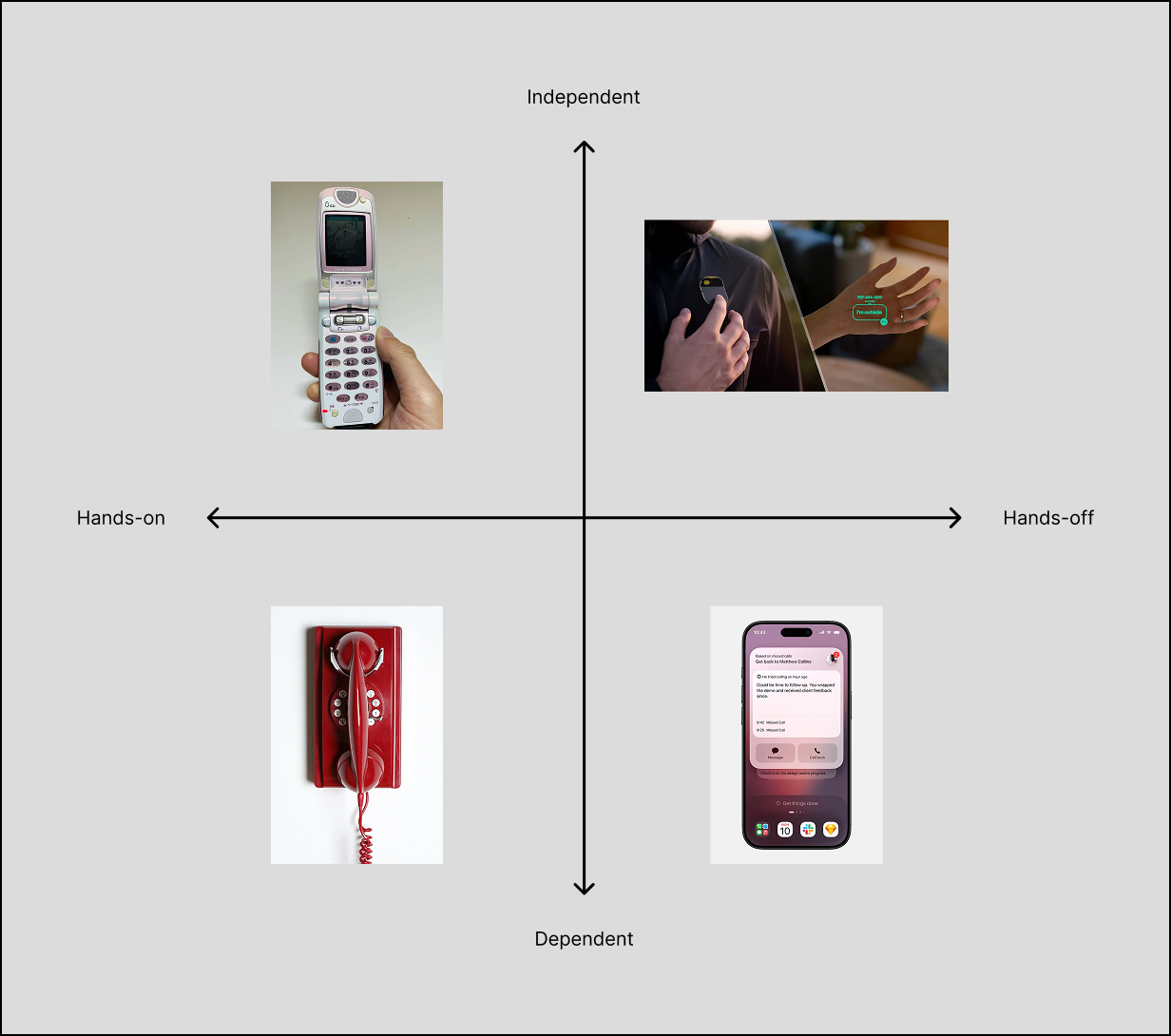
Per the assignment, I identified and created a 2D matrix for this investigation into the future of phone design. I utilized the lens between attatchment: dependence or independence, and the physicallity of operation: hands-on, or hands-off.
2D Matrix
Requiring manual input for activation.
Requiring no input for activation.
The phone does not depend on us to complete a task.
The phone depends on us to complete a task.
Future Cone
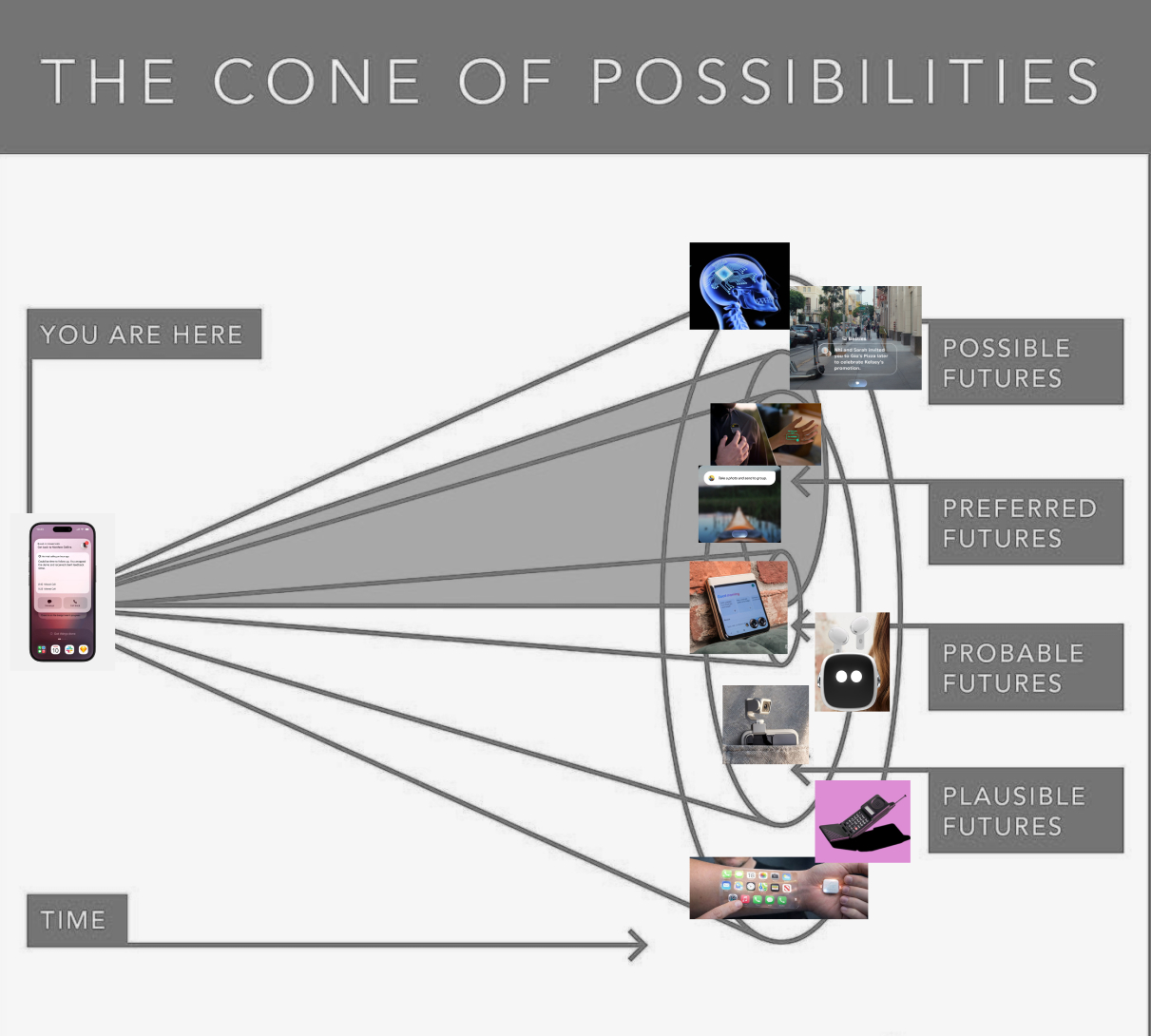
Touchscreen phones with built-in assistants that speed up workflows and task completion.
Neuro-interfaced computing, Chip augmentation, rejection of technology, mass return to the analog, touch-less phones, optic-computing.
Phone-robotics, audio-computing, AI-first phones, agentic phones, autonomous phones that "see" your world, AR-first computing.
AI-first human activated phones, agentic task completion, predictive assistance, minimal footprint, just-in-time surfacing and information relevance.
The Object
Charachteristics
This future phone render explores my preferred future, based on the trajectory of current trends and explorations from tech R&D efforts of today. The concept takes a "forget it until I need it" stance to the relationship we'll have with phones. With our growing sentiment towards digital lethargy, I believe there will be a cull in the over-digitalization of our daily devices. We're seeing this with the trend of "analog devices" and tactile items such as physical books.
While we will continue to crave the conevenience that ai-assited experience are prpoviding, we will seek to cling on to the control we have over such a technology. The act of "summoning" the assistant will be pivitoal for growing adoption as the boundaries between agency and permission begin to dissolve.
My take on this future phone is one that is portable, reliant on the user for activation, but ambient in it's use of the user's life: remembering the important details, patterns, and individuality of it's primary user to serve the ultimate function of convenience through knowledge and presence. The "phone" is a small air-tag sized computing device that you can throw in your pocket, around your neck, pin to your shirt or backpack, and interface by simply holding or touching it's screen.
You are greeted by your phone as a sort of pocket-secretary, predicting what you most likely need in the moment you're using it. Through this, we shift our dependency from our current phones, trapping us into this circular cycle of call and response, to command and release.

The Scene
Charachteristics
This scene captures the future phone UI in use. The small profile allows users to cusp the phone with a single hand, and simplyt talk to their assistant. The industrial design is meant to be minimal, sleek, inviting, and unobtrusive for everyday carry.